Ansys Fluent:
One Environment for the Full CFD Workflow
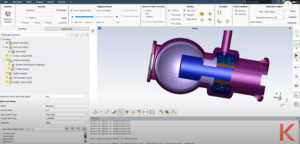
Fluent gives you pre-processing, solving, and post-processing in one window. The task-based workflow walks a new analyst through meshing without a 200-page manual, while the underlying pressure-based, density-based, and GPU solvers give a senior engineer the control needed for compressible, reacting, and multiphase work. Sessions can run on a laptop for early sizing or scale to a thousand cores when a transient run needs it.
- Single-window workflow from CAD import to result animation
- Task-based meshing, with a watertight-geometry option for messy CAD
- Native GPU solver with significant runtime drops on commodity GPUs
- Validated physics for turbulence, multiphase, reacting flow, and battery

Spotlight: GPU acceleration without a custom workflow
Fluent’s native GPU solver runs the same setup file as the CPU solver. No model conversion, no exotic preprocessing. For steady-state pressure-based runs and an expanding set of transient and multiphase models, the GPU path cuts wall time by an order of magnitude on a single workstation, which is the difference between testing four geometry variants in a sprint and testing none.
Ansys Fluent Highlights
HFSS’s unmatched capacity, coupled with indisputable accuracy, enables engineers to address RF, microwave, IC, PCB, and Ansys Fluent is built for the breadth of work a modern CFD engineer takes on, from turbulent flow and compressible flow to conjugate heat transfer, multiphase flow, reacting flows, and fluid structure interaction. The same fluids simulation software handles a quick incompressible flow sizing run and a full multiphysics simulation with the same model setup, the same meshing, and the same solver foundation rooted in the Navier-Stokes equations. That breadth is what makes Fluent the CFD simulation software engineers reach for when fluid dynamics, heat transfer, and flow field accuracy all have to hold up in the same project. EMI problems for most complex systems.
Applications: Where Ansys Fluent goes to work
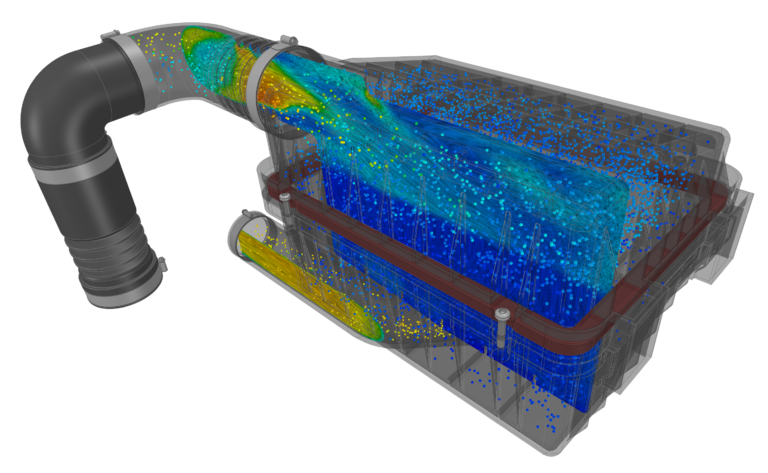
Engineers run Ansys Fluent across every industry where fluid behavior, heat transfer, or reacting flows shape the outcome of a design. The same CFD simulation software covers aerospace external aerodynamics, battery thermal management, industrial flow through process equipment, and HVAC distribution in occupied spaces, with the simulation workflow adapting to the physics rather than the other way around. The applications below show where Fluent’s fluid dynamics simulations earn their place in manufacturing engineering and product development programs.
Aerospace and external aerodynamics
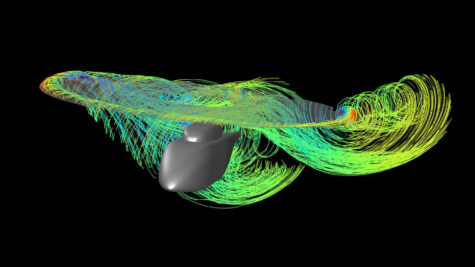
Compressible flow, transonic and hypersonic regimes, in-flight icing studies, and store-separation analyses. Fluent has the validated physics for fixed-wing, rotorcraft, and launch-vehicle work, plus adjoint-based shape optimization for clean drag reductions.
Process equipment and reactors
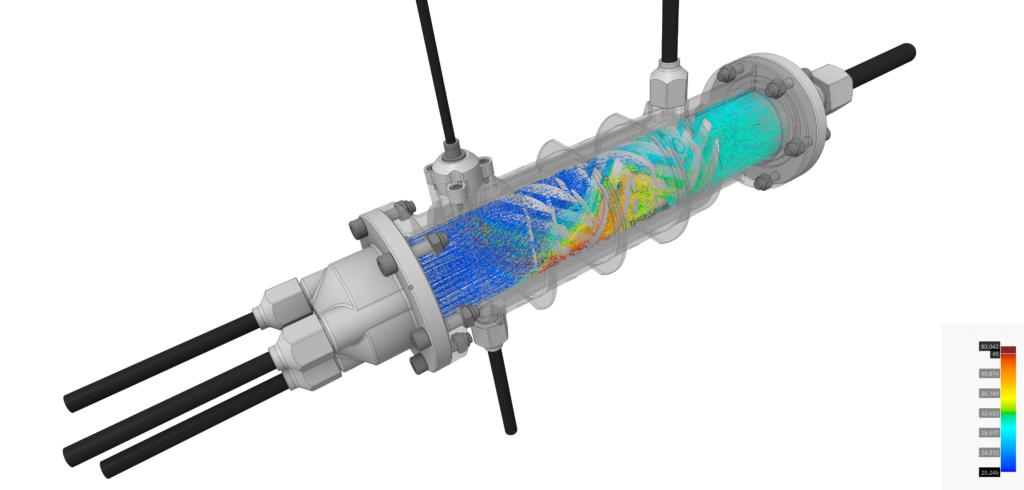
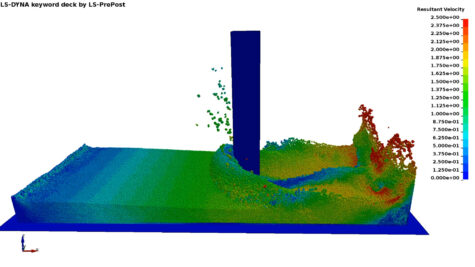
Mix-quality predictions in stirred tanks, residence-time distributions in continuous reactors, and erosion mapping in slurry pipes. Pair Fluent with Rocky for full CFD-DEM in fluidized beds and granular flows.
Batteries and electric powertrain
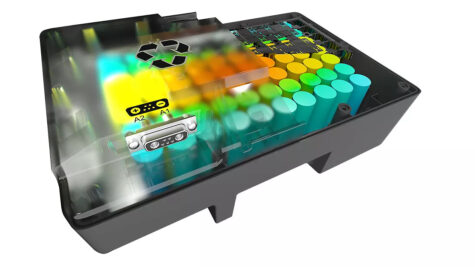
Cell-level conjugate heat transfer, pack-level thermal runaway propagation, and cooling-circuit pressure-drop studies. The MSMD framework handles the multi-scale electrochemistry that drives pack-level outcomes.
Building HVAC and indoor air quality
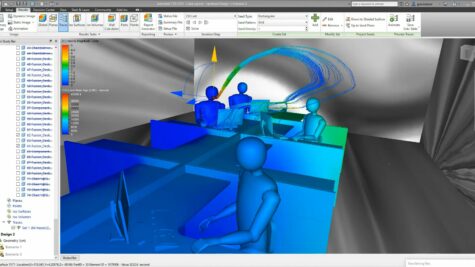
Predict thermal comfort, contaminant transport, and ventilation effectiveness in occupied spaces. KETIV’s on-demand session Simulating Safe HVAC Systems with Ansys Fluent walks a working example end-to-end.
Ansys Fluent CFD software capabilities
Key Features
Fluent is built to be the CFD code you can always rely on. It brings decades of physics validation, a meshing workflow that reflects how engineers actually receive CAD, and a solver that has moved with the hardware, from multi-CPU to multi-GPU, with web and cloud next.
- Pressure-based and density-based solvers, with a native GPU pressure-based solver
- Watertight-geometry meshing for production CAD, plus fault-tolerant meshing for messy assemblies
- Validated turbulence model library (k-ε, k-ω SST, GEKO, SAS, DES, LES, WMLES)
- Multiphase: VOF, mixture, Eulerian, DPM, EDEM/Rocky coupling for particles
- Reacting flow: finite-rate chemistry, EDC, FGM, partially-premixed combustion
- Adjoint shape optimization and design-of-experiments through Workbench parametric
- Battery thermal and electrochemistry via the MSMD framework
Task-based meshing for production CAD
The task-based mesher walks the analyst through a fixed sequence (describe the geometry, identify boundaries, set sizing, generate volume mesh) and remembers the answers when the geometry updates. The watertight-geometry workflow assumes the CAD is clean; the fault-tolerant workflow handles the case where it isn’t. Either way, you’re not back-tracking through dozens of dialog boxes when the part revs.
Native GPU solver
The pressure-based solver runs on commodity NVIDIA GPUs without recompiling models or re-meshing. For steady-state runs covering a growing list of physics models, runtime reductions of 5 to 10x on a single GPU are routine. The point isn’t a marketing benchmark; it’s being able to test more design candidates inside the calendar window the program owner gave you.
Validated turbulence physics
Fluent ships the standard model library plus the GEKO model, which exposes physically meaningful coefficients an engineer can tune for separation, jet spreading, or mixing-layer behavior. For wall-bounded flows where SST is the default, near-wall treatment switches between low-Re and wall-function modes based on the local mesh, which means fewer manual decisions and fewer y-plus-related restarts.
Multiphase and free-surface
Volume of Fluid for sloshing, mixture and Eulerian for dispersed phases, and the Discrete Phase Model for sprays. Each formulation has its sweet spot. KETIV engineers can help you decide which one fits the physics before you spend a week meshing for the wrong solver.
Reacting flow and combustion
Premixed, non-premixed, and partially-premixed combustion models for gas-turbine, IC-engine, and burner work. Couple to Chemkin-Pro mechanisms for detailed kinetics or use FGM for production-speed predictions of NOx and CO.
Adjoint-based shape optimization
The continuous adjoint solver computes geometric sensitivity to a chosen objective (drop pressure loss across a manifold by 12%, for instance). Apply the resulting morphing field to the mesh, re-run, and you have a CAD-ready geometry update without parameter sweeps.
Battery and electric thermal
The MSMD framework couples electrochemistry, conjugate heat transfer, and pack-level thermal runaway behavior in one model. For OEMs sizing cooling plates and for cell suppliers tuning chemistry, the workflow keeps everything in one solver instead of bouncing data through three.
Workflow automation: expressions and journals
Fluent expressions let you define boundary conditions, initial fields, and post-processed variables symbolically rather than through user-defined functions. KETIV’s Virtual Academy session Using Ansys Fluent Expressions to Simplify Setup and Post-Processing covers the patterns most teams adopt first: time-varying inlets, conditional sources, and post-processed quantities engineering managers tend to ask for.
Design exploration with parametric studies
Drive Fluent through Workbench to sweep geometric or operating parameters, then surface results to a response surface or use them as training data for a reduced-order model.
Ready to start working with Ansys Fluent?
Frequently asked Ansys Fluent questions
-
Ansys Fluent is general-purpose CFD software used to predict fluid flow, heat transfer, turbulence, multiphase behavior, and reacting flow inside and around a design. Engineers use it for everything from aerospace external aerodynamics and battery thermal management to HVAC, combustion, mixing, and shape optimization, anywhere physical prototyping is too slow or too expensive to iterate on.
-
Yes. Fluent ships a native GPU solver that runs the same setup file as the CPU solver, no model conversion, no re-meshing. For steady-state pressure-based runs and a growing set of transient and multiphase models, the GPU path typically cuts wall time by 5 to 10x on a single commodity NVIDIA GPU. That’s the difference between testing four geometry variants in a sprint and testing none.
-
Yes. Fluent covers the full range: Volume of Fluid (VOF) for free-surface and sloshing, mixture and Eulerian formulations for dispersed phases, and the Discrete Phase Model for sprays and particle-laden flows. For granular and bulk solids work, Fluent couples two-way with Ansys Rocky for full CFD-DEM in fluidized beds, slurry pipes, and pneumatic conveying.
-
Yes. Fluent includes premixed, non-premixed, and partially-premixed combustion models for gas-turbine, IC-engine, and burner work. Couple to Chemkin-Pro mechanisms for detailed kinetics or use the Flamelet Generated Manifold (FGM) approach for production-speed predictions of NOx and CO.
-
Yes. Fluent’s continuous adjoint solver computes geometric sensitivity to a chosen objective, for example, reducing pressure loss across a manifold by 12%. You apply the resulting morphing field to the mesh, re-run, and end up with a CAD-ready geometry update without running full parameter sweeps.
-
Yes. The task-based meshing workflow has two paths: watertight geometry for clean production CAD, and fault-tolerant meshing for assemblies that come in with gaps, overlaps, or missing surfaces. Either way, the mesher remembers your inputs so geometry revisions don’t send you back through dozens of dialog boxes.
-
US-based technical support from engineers who run Fluent every day. That includes deployment, training, workflow optimization, and direct help when a project hits a wall, meshing snags, convergence problems, GPU configuration, or matching solver choice to your physics. KETIV is an Ansys Select Channel Partner with full access to Ansys resources plus a local team who knows your account.