
Ansys Rocky DEM Particle Simulation Software
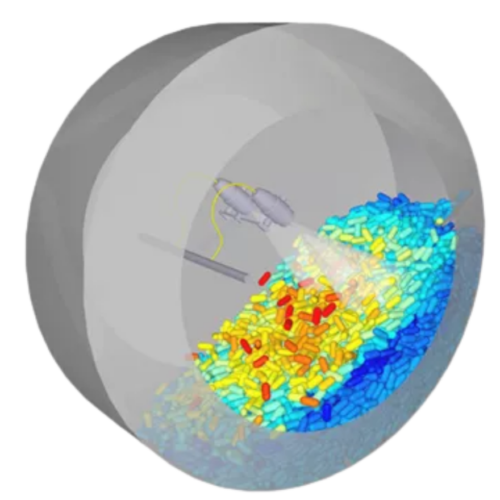
What is Ansys Rocky?
Ansys Rocky is a discrete element method solver built for particulate systems where shape, scale, and coupling all drive the outcome. The software uses tetrahedral discretization to represent particles the way they actually are, runs on multi-GPU hardware for runs in the millions of particles, and couples to Fluent, Mechanical, and Maxwell so particle physics never has to live in isolation. Where sphere-based DEM codes lose the geometry that matters, Rocky preserves it.
Ansys Rocky models particles the way they actually move
Most DEM codes approximate a particle as a cluster of glued spheres. That works for round-ish particles but falls apart for anything that flows because of shape, like wood chips, ore, granulated tablets, or conveyor riprap. Rocky uses tetrahedral discretization, so the simulated particle has the geometry the part actually has: corners catch on corners, fibers bend and break, flat plates stack the way plates stack.
- Tetrahedron-based shapes including solids, 2D shells, and rigid and flexible fibers
- Multi-GPU solver scaling to millions of shape-accurate particles
- Two-way coupling with Fluent (CFD-DEM) and Mechanical (FEA-DEM)
- Coupling with Maxwell and EMA3D Charge for charged-particle problems
💡Spotlight: When shape changes the answer
Iron-ore pellet flow in a chute, biomass moving on a conveyor, pharmaceutical tablets tumbling through a coating drum. These processes can’t be modeled with spheres without losing the physics that determines outcome. Rocky’s tetrahedral particles preserve volume and mass exactly while letting shape do its work: jamming a transfer point, segregating by length in a vibratory feeder, or shifting load distribution in a stockpile.
Ansys Rocky highlights
Ansys Rocky is built around the physics that decides whether a particle simulation matches what happens on the plant floor: shape-accurate contact, breakage, wear, cohesion, and coupling with the fluid, structural, and electromagnetic domains the particles interact with. The same DEM software handles a quick chute study, a multi-million-particle mill run, and a coupled CFD-DEM fluidized bed without changing tools. The highlights below are what process and material-handling engineers reach for first when particle shape, scale, and surrounding physics all have to be modeled together.
Ansys Rocky applications
Engineers run Ansys Rocky across every industry where particle behavior drives process outcomes. The same DEM software covers mining and bulk material handling, pharmaceutical mixing and coating, food processing, agricultural and biomass flow, and powder spreading in additive manufacturing, with shape-accurate particles that capture the physics sphere-based codes miss. The applications below show where Rocky’s particle simulation earns its place in process design and equipment optimization work.
Mining and bulk material handling
Stockpile management, transfer-point design, conveyor wear, chute optimization, and mill liner life. KETIV’s blog, Overcome Material Handling Challenges with Particle Simulation, covers the patterns most material-handling teams use Rocky for first.
Pharmaceutical and food processing
Tablet coating, mixing in conical and ribbon blenders, fluidized-bed granulation, and segregation in tablet hoppers. Shape-driven phenomena that sphere-based DEM gets wrong
Agriculture and biomass
Grain flow in combines and storage, biomass feed to industrial boilers, and fertilizer dispersion patterns. Flexible-fiber support handles straw, stalks, and wood-chip mixes.
Additive manufacturing and powder handling
Powder spreading in metal AM, packing density studies, and powder-bed integrity during recoating. Rocky predicts what the spread layer looks like, not what it ought to.
Ansys Rocky DEM software capabilities
Rocky’s depth comes from a particle physics foundation built for production-scale problems and the coupling story that connects it to the rest of the simulation stack. The tetrahedral particle representation, multi-GPU solver, and breakage, wear, and cohesion models sit inside one environment, with CFD-DEM, FEA-DEM, and EM-DEM coupling that lets particle behavior interact with fluids, structures, and electromagnetic fields.
Where Rocky earns its license
Rocky predicts how a population of particles behaves. It does that with physics that are built for particular shapes, scale, and coupling. The DEM contact model handles cohesion, adhesion, and breakage. The visualization keeps up with multi-million-particle runs. The coupling story makes it possible to put a particle stream inside a process model rather than studying it in isolation.
Key Features
- Tetrahedral particle representation that preserves volume and mass exactly
- Multi-GPU solver with new distributed multi-node support in 2026 R1
- Breakage models (Tavares, Ab/T-10) for particles of any aspect ratio
- Wear models that predict liner and chute surface erosion
- Coupling with Fluent (CFD-DEM), Mechanical (FEA-DEM), and Maxwell or EMA3D Charge (EM-DEM)
Shape-accurate particles
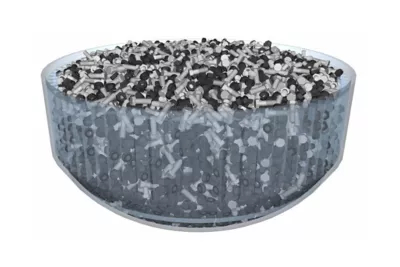
Particles are constructed from tetrahedra rather than approximated as clumps of spheres. Volume and mass are preserved exactly across resolution levels, breakage products inherit the original geometry, and contact patches reflect surface meeting surface.
Multi-GPU scaling
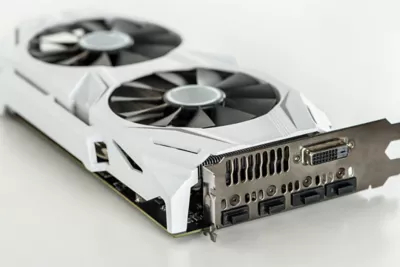
Rocky is GPU-native. A single high-end card runs simulations that would tie up a CPU cluster for days. The 2026 R1 distributed-parallel beta adds multi-node scaling so a GPU cluster can address full-plant problems without sub-domain stitching.
CFD-DEM coupling with Fluent
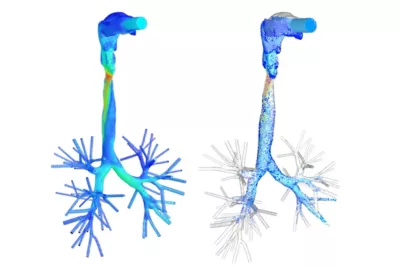
Two-way coupling means Fluent solves the fluid phase, Rocky solves the particles, and momentum and heat exchange every coupling step. Useful for fluidized beds, slurry pipelines, spray drying, and pneumatic conveying. Combine with the patterns from KETIV’s “Which Ansys CFD product is right for you?” event when scoping a CFD-DEM problem.
FEA-DEM coupling with Mechanical
Pass particle loads into Ansys Mechanical to evaluate structural response: liner deflection under ore impact, chute wall fatigue under conveyor loading, mill shell stress under operating loads.
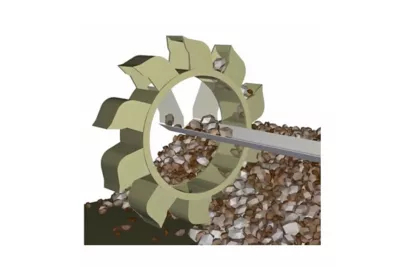
EM-DEM coupling with Maxwell and EMA3D Charge
For charged particles in electric or magnetic fields (electrostatic separation, fluidized-bed reactors with corona charging, powder coating) Rocky couples to Maxwell and EMA3D Charge so the field, charge state, and motion stay consistent.
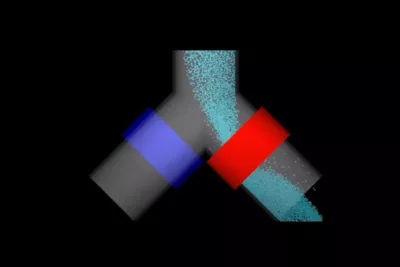
Breakage models
The Tavares and Ab/T-10 breakage models predict size-distribution evolution as particles fracture under impact and shear. Mill optimization, crusher design, and screening-deck studies use these directly.
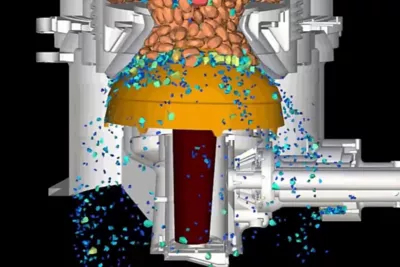
Cohesion, adhesion, and wear
Sticky materials like wet sand, ore fines, and food powders behave differently than dry granular streams. Rocky includes cohesion and adhesion contact models for these, plus wear models (Archard, Finnie) that predict surface erosion on liners, chute walls, and impact plates.
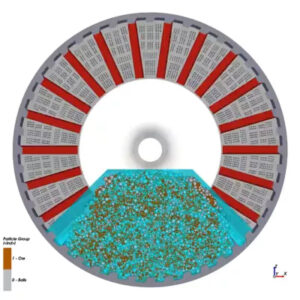
Custom shapes and flexible fibers
Import an STL or define a parameterized shape and Rocky generates a tetrahedral representation. Flexible-fiber support models straw, biomass stalks, and elongated particles that bend, break, and tangle.
Ready to start working with Ansys Rocky?
Frequently asked Ansys Rocky questions
-
Ansys Rocky is a discrete element method (DEM) solver for particulate and granular systems. Engineers use it to predict how pellets, rocks, fibers, tablets, powders, and other particles flow, segregate, break, and wear surfaces. Typical applications include conveyor and chute design, mill optimization, tablet coating, fluidized-bed reactors, biomass handling, powder spreading in additive manufacturing, and any process where particle behavior drives outcomes.
-
DEM is a numerical technique for simulating the motion and interaction of large numbers of individual particles. Each particle is tracked separately, with contact forces, friction, cohesion, and breakage resolved at every time step. DEM gives you visibility into bulk material behavior (segregation in a hopper, wear in a chute, packing density in a powder bed) that empirical correlations and continuum models cannot capture.
-
Two things. First, Rocky uses tetrahedral discretization to represent the actual shape of each particle, instead of approximating particles as clusters of glued spheres. That matters for anything where shape drives the physics: wood chips, ore, tablets, fibers, riprap. Second, Rocky is GPU-native and scales to millions of shape-accurate particles on a single workstation, with multi-node distributed support in the 2026 R1 release.
-
Yes. Rocky has been GPU-native for years. A single high-end NVIDIA card runs simulations that would tie up a CPU cluster for days. The 2026 R1 distributed-parallel beta extends this to multi-node GPU clusters, which means full-plant problems can be addressed without sub-domain stitching.
-
Yes. Rocky offers two-way coupling with Ansys Fluent for CFD-DEM problems. Fluent solves the fluid phase, Rocky solves the particles, and momentum and heat exchange every coupling step. This is the standard workflow for fluidized beds, slurry pipelines, spray drying, and pneumatic conveying. Rocky also couples with Ansys Mechanical for FEA-DEM (structural response to particle loading) and with Maxwell or EMA3D Charge for EM-DEM (charged particles in electric or magnetic fields).
-
Rocky supports a wide range of shapes built from tetrahedra: solid 3D particles, 2D shells, rigid fibers, flexible fibers that bend and break, and custom shapes imported from STL or defined parametrically. Volume and mass are preserved exactly across resolution levels, and breakage products inherit the parent geometry.