
As shallow oil and gas reserves deplete, drilling goes deeper. And deeper means harder rock, higher temperatures, higher pressures, and slower progress. In some deep formations, the drill bit becomes the bottleneck.
Particle Impact Drilling changes the equation. Field tests by Particle Drilling Technology Inc. (PDTI) in 2011 showed penetration rates two to four times higher than conventional drilling in hard formations. In laboratory conditions, the technology has demonstrated more than seven times the penetration ability of water jet impact drilling alone.
But there’s a catch. Actually, several catches.
How particle impact drilling works
The concept is straightforward: add hardened steel particles to the drilling fluid. Accelerate them through specialized nozzles to near-sonic velocities. The particles shatter the rock face on impact, creating fracture zones and damage areas that the drill bit then clears away.
Unlike traditional drilling, particle impact doesn’t rely primarily on weight-on-bit or torque. The rock breaks from impact energy. This means less wear on the bit teeth, less downhole equipment stress, and faster progress through formations that would normally chew through conventional bits.
The system fits into existing drilling operations. You add a particle injection device and a specialized bit with accelerating nozzles, cutting teeth, and diameter-maintaining features. No major rig modifications required.
The full engineering challenge
Erosion is the obvious problem, but it’s not the only one. Particle impact drilling involves multiple interacting physics that all need to be optimized together.
Vibration and tool dynamics affect everything downhole. High-velocity particle impacts create dynamic loads on the bit and drill string. Understanding how these loads couple with the mechanical system, and how vibrations propagate and potentially cause fatigue or failure, requires fluid-structure interaction (FSI) analysis.
Thermal effects matter more than you might expect. Particle impacts generate heat. Friction between particles and equipment generates heat. In deep wells with already elevated temperatures, thermal management becomes critical. Heat affects material properties, accelerates wear, and can cause thermal stresses that contribute to equipment failure.
Nozzle clogging and flow instability can shut down operations. Particles need to flow smoothly through the injection system and nozzles. But particles can accumulate, bridge, and clog. Flow instabilities can cause pulsation that affects drilling performance. Understanding multiphase flow behavior through the entire system is essential.
Hydraulic optimization determines how much energy actually reaches the rock face. Pressure drops through the drill string, nozzle acceleration efficiency, and bottom-hole fluid dynamics all affect performance. Every bit of hydraulic energy lost to friction or turbulence is energy not breaking rock.
Equipment lifespan prediction drives economics. How long will the bit last? How often will the injection system need maintenance? Understanding wear rates, fatigue accumulation, and failure modes lets you plan maintenance and calculate true operating costs.
The physics behind particle impact drilling
Research has shown that rock-breaking efficiency increases with pressure, particle size, and particle hardness. But the relationship isn’t linear. At lower velocities, efficiency is modest. When average particle velocity exceeds 160 meters per second, efficiency increases significantly.
Particle concentration matters too. Higher concentrations generally improve efficiency, but there’s an optimum. When concentration gets too high, particle collisions interfere with each other, and equipment wear accelerates.
The challenge is optimizing across all these variables simultaneously, maximizing rock destruction while minimizing equipment erosion, controlling thermal effects, maintaining flow stability, and extending equipment life.
What simulation enables
You can’t see what’s happening at the bottom of a deep well. You can measure penetration rate and equipment wear after the fact, but that’s expensive feedback.
Simulation lets you model the entire system before drilling starts:
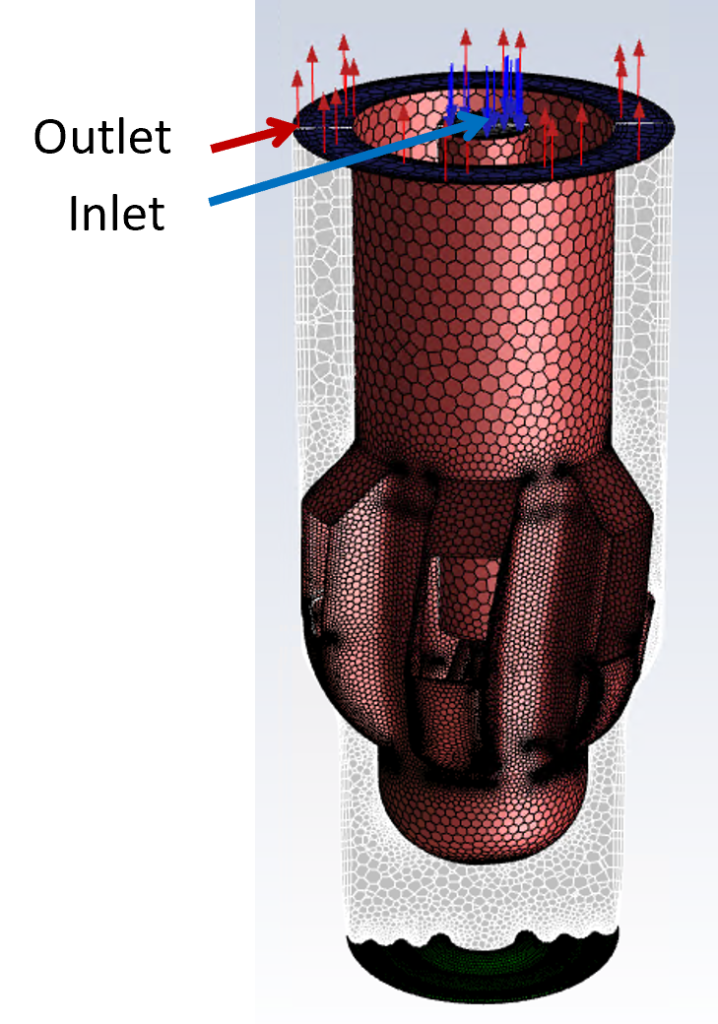
Ansys Fluent handles the fluid dynamics, from hydraulic optimization through the drill string to nozzle flow and bottom-hole conditions. It captures heat transfer, pressure distributions, and flow patterns.
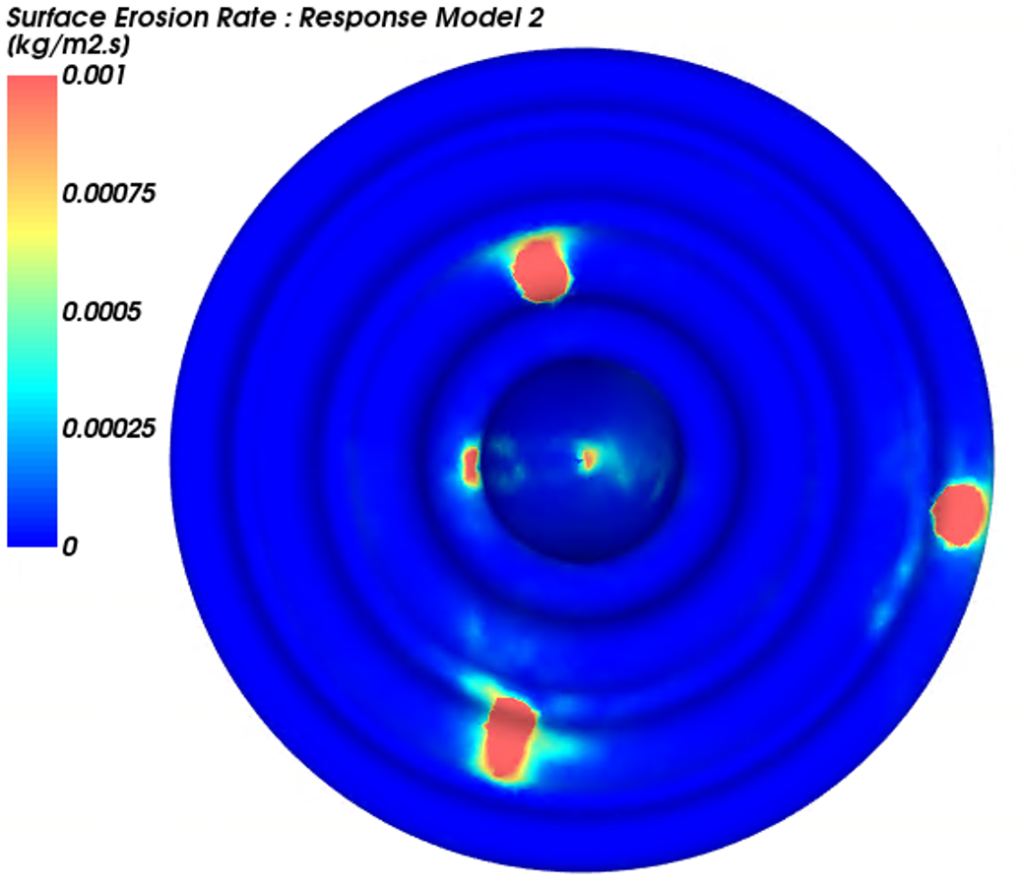
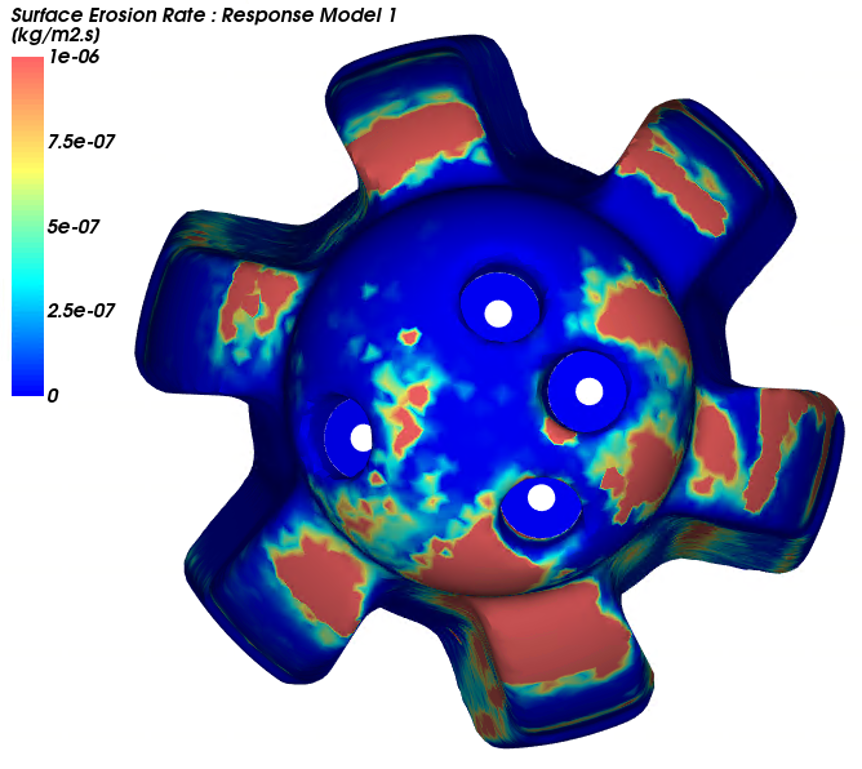
Ansys Rocky models particle behavior, tracking individual particles through acceleration, impact, and interaction. It predicts erosion patterns and wear rates.
Coupled Fluent-Rocky analysis captures the full multiphase physics, how particles interact with the fluid, how particle loading affects flow, and where instabilities might develop.
Mechanical and FSI coupling addresses vibration and structural dynamics, predicting how impact loads affect the drill string and identifying potential fatigue issues.
Studies using coupled CFD-DEM simulation have examined variables like nozzle geometry, standoff distance, particle concentration, and fluid velocity. Sensitivity analyses identify which parameters have the biggest impact on performance. Optimization workflows can search for configurations that balance all the competing objectives.
Field test planning becomes targeted rather than exploratory. Instead of testing dozens of configurations, simulation narrows the search to the most promising candidates.
The path forward
Particle Impact Drilling is an emerging technology with significant potential for deep-well hard rock drilling. The fundamental physics are well understood. The engineering challenge is optimization across multiple interacting domains, and that’s where simulation provides leverage.
At KETIV, our simulation specialists have experience with coupled multiphysics analyses including CFD, particle dynamics, thermal effects, and structural response. We can help you model, analyze, and optimize complex systems.
Talk to our CFD specialists: ketiv.com/cfd-consultant
Explore simulation for startups and emerging technologies: ketiv.com/simulation-software-for-startups
Join KETIV Virtual Academy for free training: ketiv.com/ketiv-virtual-academy