
Pump simulation solutions
Physics-based performance prediction, right-first-time designs, and compliance with US energy standards. Ansys simulation, delivered and supported by KETIV.
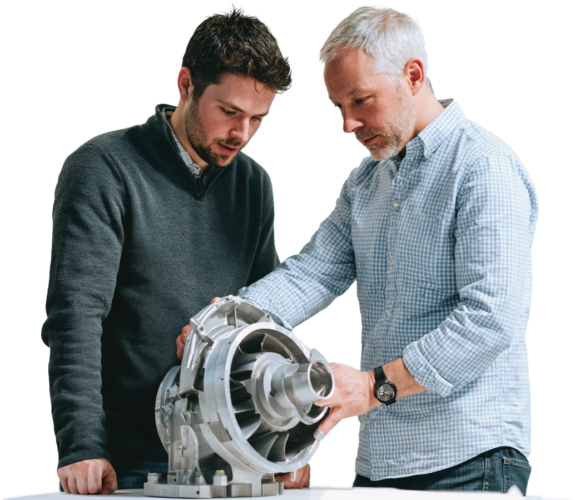
Design with confidence before you build
Pump manufacturers face stricter energy regulations, wider operating ranges, and shorter development cycles. Ansys multiphysics simulation replaces trial-and-error with a predictive process. By modeling fluid flow, cavitation, structural behavior, and system interactions before a prototype exists, engineering teams can optimize hydraulic performance, validate efficiency targets, and confirm compliance during design.
KETIV, an Ansys Select Channel Partner and Autodesk Gold Partner serving US manufacturers since 1983, provides the software, the setup, the training, and the engineering support behind it.
Pump types you can simulate
Pump simulation uses computational fluid dynamics (CFD) and finite element analysis (FEA) to predict how a pump will perform before a prototype is built: its head-flow curve, best efficiency point (BEP), net positive suction head required (NPSHr), cavitation behavior, impeller stresses, and vibration.
Centrifugal pumps
End-suction, split-case, multistage, and vertical turbine, including inducers and diffuser stages
Axial-flow and mixed-flow pumps
Including diffuser and bowl stages
Submersible and well pumps
Including motor cooling and thermal limits
Positive displacement pumps
Gear, vane, screw, and piston designs, including internal leakage
Slurry, solids-handling, and multiphase pumps
Including gas entrainment and erosion wear
Circulators and HVAC pumps
Including variable-speed operation
Why simulate pump design?
Improve performance and efficiency. Predict head, efficiency, and power across the full operating range and optimize the hydraulic design before casting.
Increase reliability and durability. Identify cavitation, stress, fatigue, and vibration risks before they reach the test floor or the field.
Meet regulations and sustainability goals. Design to US Department of Energy efficiency standards and document compliance with industry standards such as API 610.
Reduce cost and time to market. Replace physical prototype iterations with virtual ones and shorten the design cycle.
Solutions for pump manufacturers
Hydraulic performance
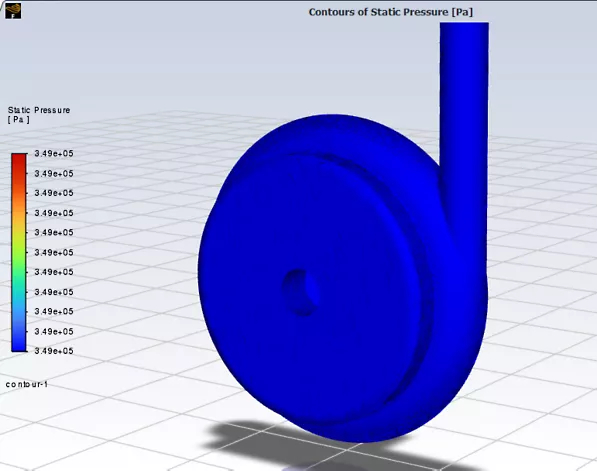
Predict the complete head-flow curve, efficiency, and power at every operating point. Evaluate cavitation, pressure pulsation, and off-design behavior. Run automated design studies to compare hundreds of impeller and volute variants.
Locate the best efficiency point (BEP) and predict NPSHr by tracking head drop as suction pressure falls. Use fast steady-state (frozen-rotor) runs to build the performance curve, then transient (sliding-mesh) runs to capture blade-pass pressure pulsations, rotor-stator interaction, and recirculation at part load.
Slurry and solids handling: Predict particle transport and erosion wear on impellers, casings, and liners with Ansys Fluent. For high solids loading, large or irregular particles, and clogging risk, couple Fluent with Ansys Rocky particle simulation.
Products: Ansys Fluent, Ansys CFX, Ansys BladeModeler, Ansys TurboGrid, Ansys optiSLang.
Structural reliability
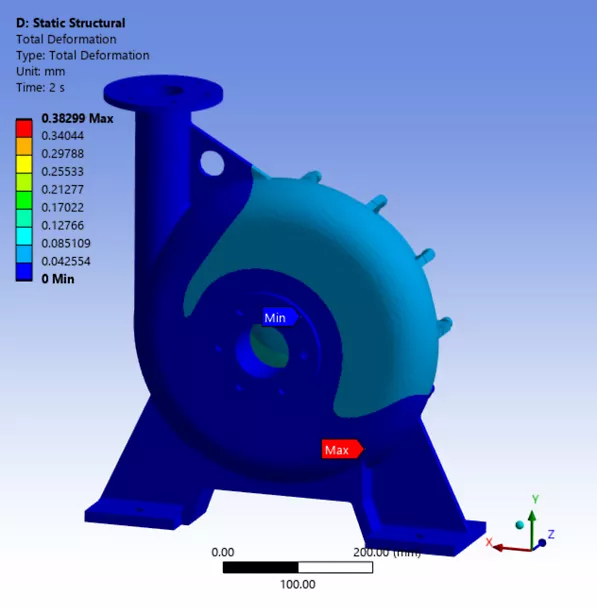
Analyze impeller stress and fatigue under real pressure loads. Verify casing strength, bolted joints, and pressure-boundary ratings by analysis. Check natural frequencies against running speed and blade-pass frequency to avoid resonance.
Map pressure loads from the CFD results directly onto the structural model (one-way fluid-structure interaction), and use Campbell diagrams from rotordynamic analysis to check critical speeds across the variable-speed range.
Products: Ansys Mechanical.
Regulatory compliance
The US Department of Energy requires clean-water pumps from 1 to 200 hp to meet a Pump Energy Index of 1.00 or lower, and circulator pumps to meet a Circulator Energy Index of 1.00 or lower from May 22, 2028. API 610, updated in June 2026, now allows pressure-boundary ratings by analysis. Simulation establishes the efficiency margin and produces the analysis documentation before certification testing.
Motors and variable-speed operation
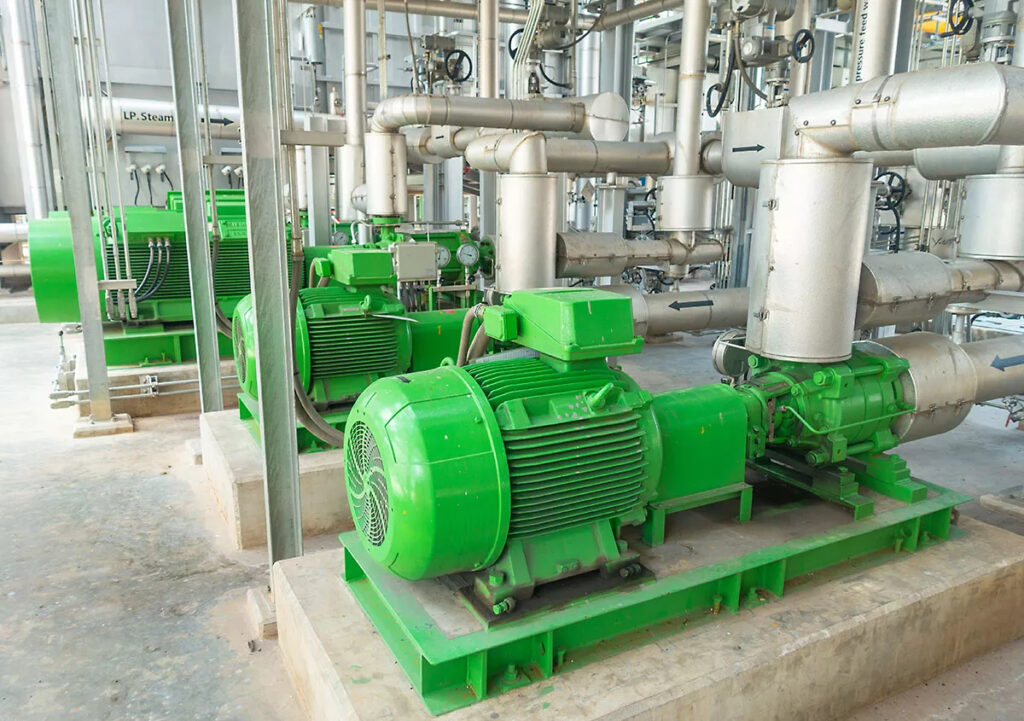
Size the motor and pump together, evaluate part-load efficiency for variable-load ratings, and assess thermal and electromagnetic limits.
Products: Ansys Motor-CAD, Ansys Maxwell.
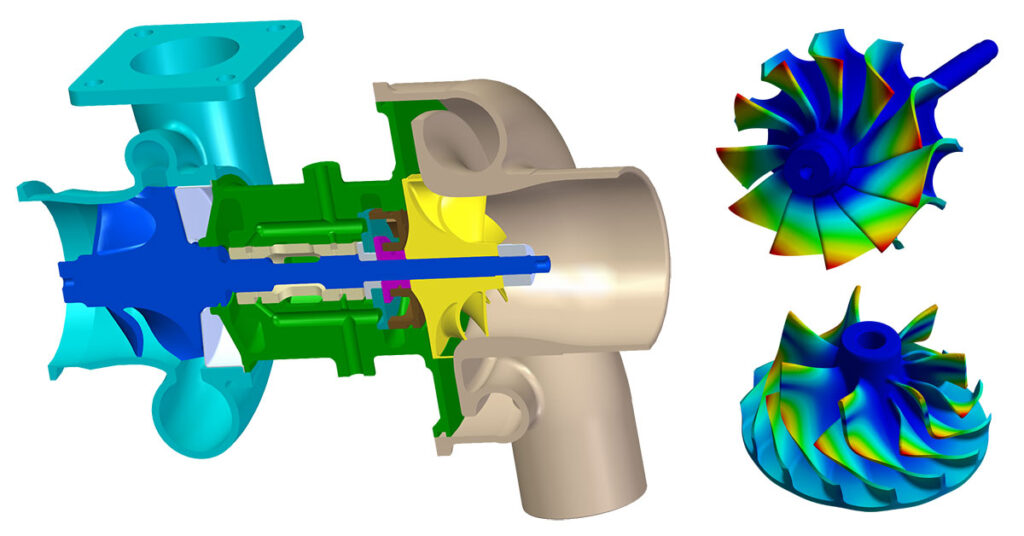
Early-stage design and AI
Test design changes in minutes with Ansys Discovery. Train an AI model on your own simulation results to screen new designs in seconds with Ansys SimAI.
Get started today with Ansys and KETIV
Featured Ansys products for pump simulation

Ansys Fluent
General-purpose CFD software with advanced physics modeling, GPU acceleration, and a single-window workflow.
Ansys CFX
CFD software with dedicated turbomachinery workflows for pumps, compressors, and turbines, including cavitation modeling.
Ansys Mechanical
Finite element analysis for structural, thermal, fatigue, and vibration studies.
Ansys Discovery
Interactive simulation for early-stage design decisions inside the CAD environment.
Ansys BladeModeler
Streamline your blade modeling and analysis.
Ansys TurboGrid
Produce a high-quality mesh for blade passages in rotating machinery.What KETIV provides
Free 30-day trial. Full Ansys software with no credit card required. A KETIV engineer evaluates the project and helps your team achieve goals with the first project.
Simulation consulting. KETIV’s simulation team builds and validates your first pump model, reviews existing models against test data, or performs the analysis for you.
Training and support. Free on-demand learning through the KETIV Virtual Academy, and technical support for Ansys and Autodesk users.
Startup program. Early-stage manufacturers can access Ansys software, implementation, training, and support at reduced cost through KETIV’s manufacturing startup program.
Design with confidence before you build

Snigdha Sarkar
Evaluate Ansys simulation on your own pump design with a KETIV engineer, or engage our consulting team for your next project. Contact KETIV to discuss your requirements.
How a pump simulation project works
A typical KETIV pump project follows five steps. Your team can run them in-house with KETIV support, or hand them to KETIV consultants.
Resources to get you started
Pump simulation FAQ
-
Pump simulation is the use of computational fluid dynamics (CFD) and finite element analysis (FEA) to predict a pump’s hydraulic and structural performance digitally. Engineers use it to predict head, flow, efficiency, NPSHr, cavitation, stresses, and vibration before building or testing a prototype.
-
Yes, when the model is set up and validated correctly. Accuracy depends on mesh quality, the turbulence and cavitation models used, and how well leakage paths and surface roughness are represented. KETIV recommends calibrating the model against at least one measured performance curve, then using it to evaluate new designs.
-
Both are used for pump design. Ansys CFX includes dedicated turbomachinery workflows for pumps, compressors, and turbines, including cavitation modeling. Ansys Fluent is a general-purpose CFD tool with broad physics, GPU acceleration, and strong multiphase and particle coupling. KETIV helps teams choose based on their pump types, physics, and existing workflow.
-
Cavitation models predict where local pressure falls below the fluid’s vapor pressure and how much vapor forms. At a fixed flow rate, engineers lower the inlet pressure step by step and track the resulting head drop. NPSHr is commonly defined at a 3% head drop, and repeating the sweep at several flow rates builds the full NPSHr curve. The same runs show where on the blade cavitation first appears, well before performance is affected.
-
Simulation predicts efficiency across the operating range before certification testing, so engineers can confirm a design meets the required Pump Energy Index or Circulator Energy Index with margin, and adjust the hydraulics if it does not.
-
Centrifugal, axial-flow, mixed-flow, multistage, submersible, positive displacement, slurry, and circulator pumps can all be simulated with Ansys, along with their motors, seals, and bearings.
-
No. KETIV’s simulation consultants can perform the analysis for you. Teams that want to run simulation in-house can start with a free 30-day Ansys trial supported by a KETIV engineer.
-
It depends on the pump’s complexity and the physics involved. KETIV scopes each project during a free evaluation and provides a timeline before work begins.